Re Cooke {1960}

✉️ Behind the Will: Re Cooke [1960] P 243 – The Unopened Envelope Will
This week’s Behind the Will looks at Re Cooke [1960] P 243 — a curious and instructive case about execution, secrecy, and intention. It asks whether a will sealed in an envelope but never read, opened, or witnessed can still be valid.
⚖️ Case of the Week: Re Cooke [1960] P 243 – When a Will Stays Sealed
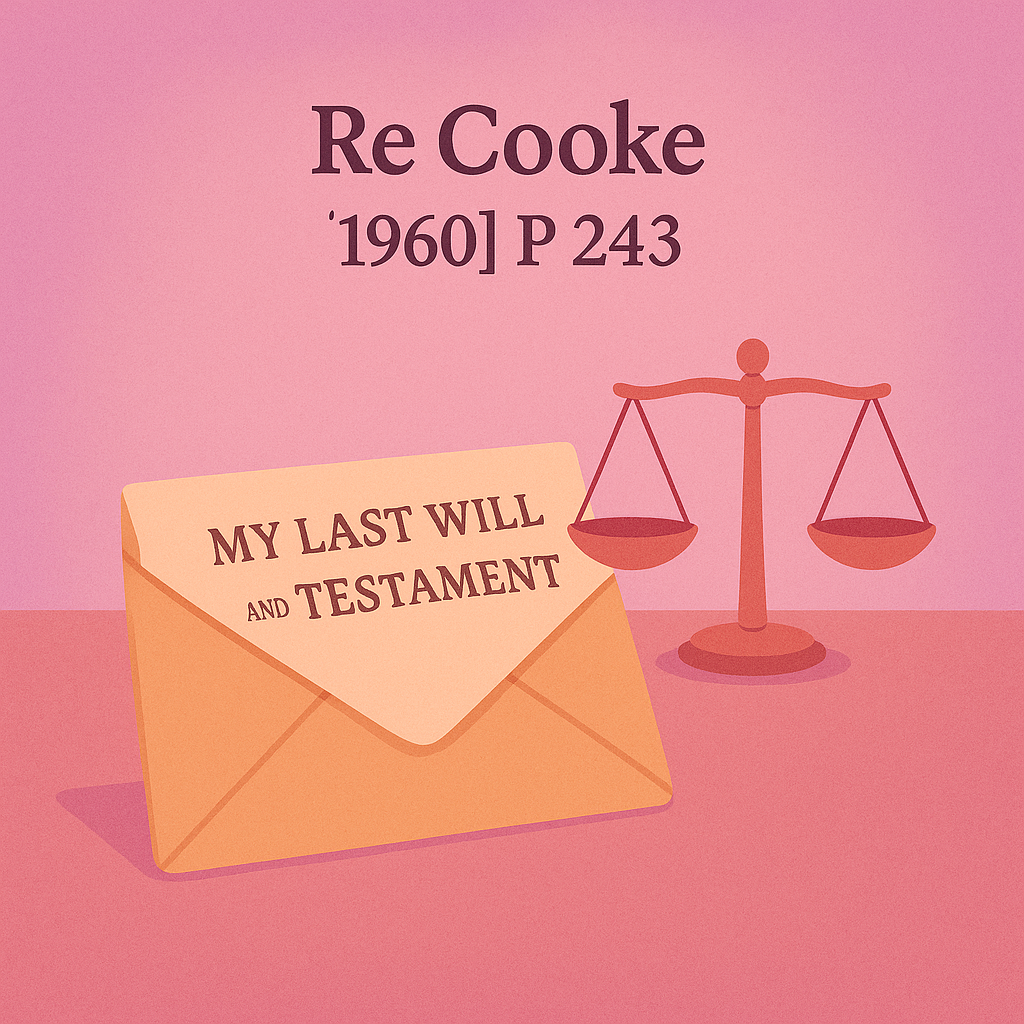
Mrs Cooke wrote out her will entirely by hand, placed it in an envelope, sealed it, and wrote on the outside:
“My Last Will and Testament – to be opened only after my death.”
After her passing, the envelope was found among her personal papers. The question was whether it could stand as a valid will, despite never having been witnessed or formally executed.
The court held that while the contents clearly expressed testamentary intention, the document failed to meet the formal execution requirements of the Wills Act 1837. Without attestation by two witnesses, the will was invalid, even though the testatrix’s handwriting and intent were clear.
However, the judgment reaffirmed that such documents may sometimes be considered under doctrines like mutual wills or secret trusts, depending on the surrounding evidence.
🔑 Key Takeaways:
1. Intention Alone Doesn’t Create a Will:
A will must comply with section 9 of the Wills Act — handwritten or not, it must be signed and witnessed.
2. “Private” Wills Are Risky:
Unwitnessed or sealed documents, no matter how clearly marked, carry no legal force unless formalities are met.
3. Equity Can Sometimes Step In:
If another person promised to carry out the deceased’s wishes, equity may impose a constructive trust — but only in exceptional cases.
4. Communication Is Crucial:
Had Mrs Cooke shared her instructions or arranged proper execution, her wishes might have been fulfilled.
💬 Practical Tip for Practitioners:
Clients often fear discussing their wills — but secrecy can undo their planning. Encourage full execution, safe storage, and open communication to avoid “envelope tragedies” like Re Cooke.
Stay tuned for next week’s Behind the Will post, where we’ll explore another curious decision showing how the smallest procedural misstep can determine the fate of an entire estate.