Re Hayward {1997}

⚰️ Behind the Will: Re Hayward [1997] EWCA Civ 2851 – When a Will Goes Up in Smoke
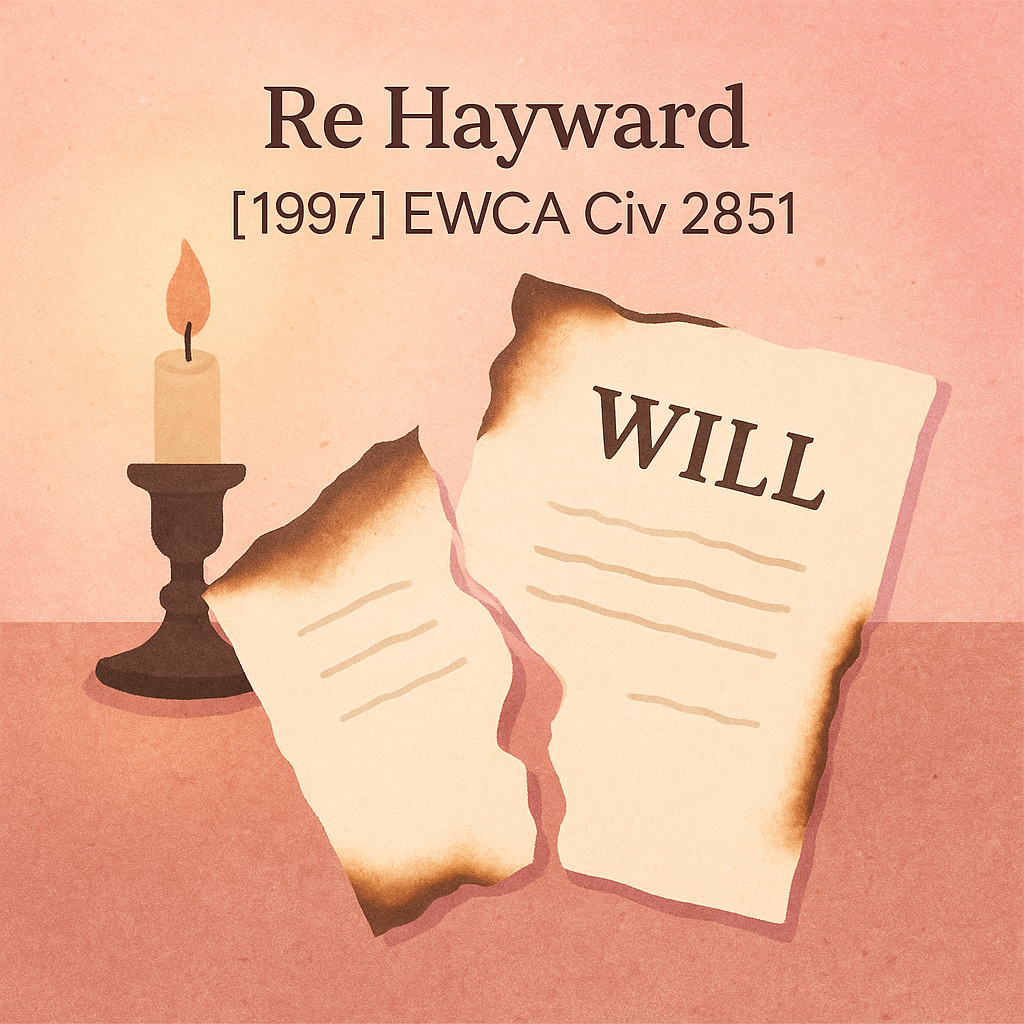
This week’s Behind the Will reviews Re Hayward [1997] EWCA Civ 2851, a striking case that explores what happens when a will is accidentally destroyed — and how the court decides whether that destruction counts as revocation.
⚖️ Case of the Week: Re Hayward [1997] EWCA Civ 2851 – The Vanished Will
Mr Hayward made a valid will in 1986, leaving most of his estate to his niece. Years later, he went through his papers and — believing the document was only a draft — accidentally tore it up and threw it away.
When he died, the will could not be found. The question for the court was simple but devastating: had he revoked his will by destroying it, even though it was by mistake?
The Court of Appeal held that revocation requires intention. The physical destruction of the will alone was not enough — it had to be accompanied by an intention to revoke. Because Mr Hayward had destroyed it by accident, the court accepted secondary evidence (a copy and solicitor’s notes) to reconstruct the will’s contents and admit it to probate.
🔑 Key Takeaways:
1. Revocation Requires Intention:
A will is only revoked by destruction if the testator intended to revoke it at the time of destruction.
2. Lost or Destroyed Wills Can Be Proved:
Courts can admit copies or secondary evidence if there’s clear proof of the original’s contents and no intention to revoke.
3. Solicitors’ Records Are Invaluable:
Good file-keeping can rescue an estate from intestacy.
4. Accidents Happen — But Law Demands Certainty:
Even honest mistakes can lead to costly litigation if intentions aren’t clearly recorded.
💬 Practical Tip for Practitioners:
If a client wishes to destroy an old will, supervise or document the act — and ensure the intention is explicit. Equally, keep secure copies of every executed will to guard against accidental loss.
Stay tuned for next week’s Behind the Will post, where we’ll explore another curious case showing how fragile the line between intention and accident can be.