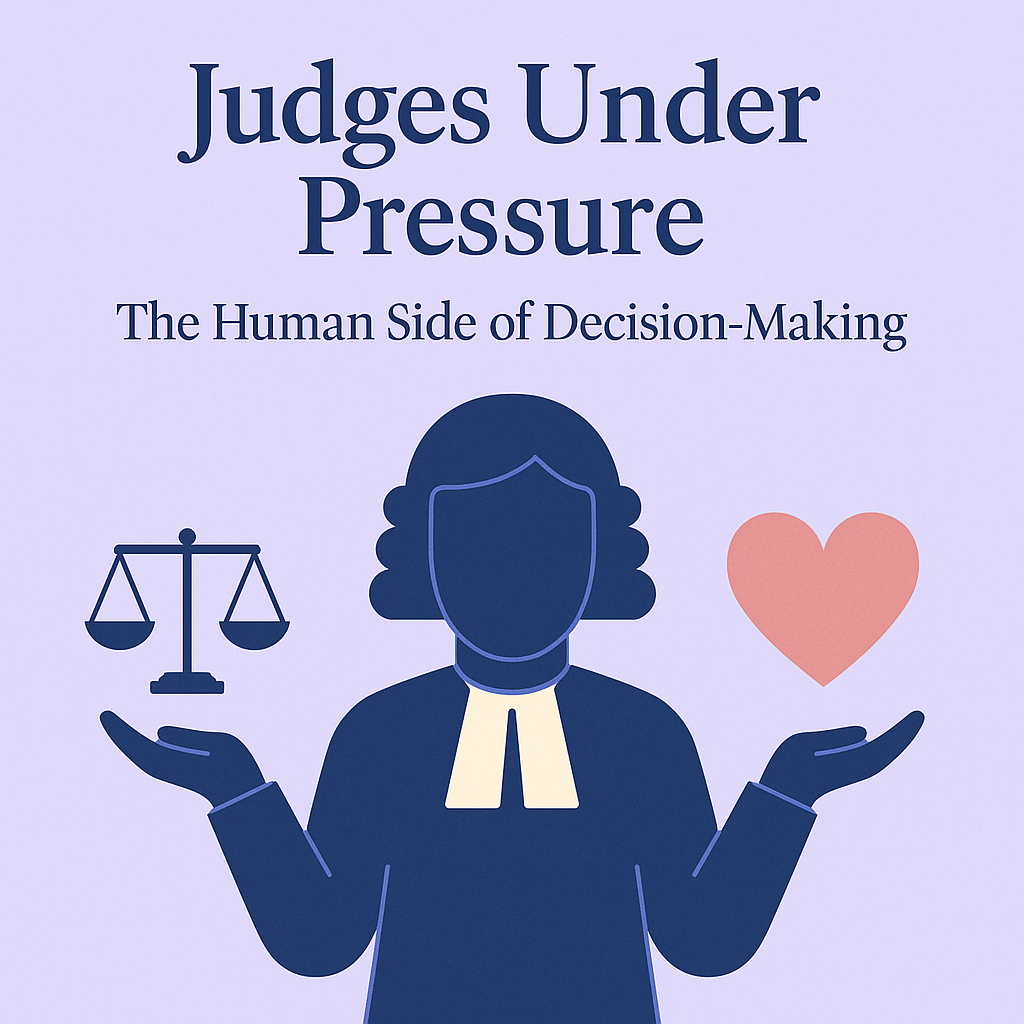
“Judges Under Pressure: The Human Side of Decision-Making”

Judges are often portrayed as detached, analytical figures applying law to fact with cold precision. But in reality, judging is a deeply human task — shaped by interpretation, emotion, and moral reasoning. The courtroom is not a sterile laboratory of logic, but a forum where law and humanity constantly intersect.
The Myth of Pure Objectivity
Classical legal theory has long upheld the image of the judge as a neutral arbiter — a figure capable of transcending bias and personal belief. However, legal realists such as Jerome Frank famously dismantled this myth, arguing that judicial reasoning is inevitably influenced by individual psychology and life experience.¹ For Frank, the “personal equation” of the judge — their upbringing, temperament, and emotional state — was as relevant as the legal principles they invoked.
Even Ronald Dworkin, who defended the idea that there is a “right answer” to every legal question, recognised that judges must interpret principles of morality and justice in order to find it.² Dworkin’s “Judge Hercules” — a hypothetical judge of superhuman intellect and moral insight — symbolises this aspiration towards perfect coherence and moral reasoning. Yet, as I explored in my own presentation on Dworkin’s theory, such perfection is unattainable in practice. Real judges are not Hercules; they are human. Law, as applied in the courts, is interpretive, contextual, and often indeterminate. My argument was that there is no single right answer in hard cases — only reasoned interpretations that reflect the judge’s understanding of justice within the framework of law.
Law and Morality in Practice: R v Brown and Nicklinson
The tension between principle and morality is vividly illustrated in cases such as R v Brown³ and Nicklinson v Ministry of Justice.⁴ In Brown, the House of Lords faced the difficult question of whether consensual sadomasochistic acts between adults could be exempted from criminal liability under the Offences Against the Person Act 1861. The majority ruled that consent was no defence to actual bodily harm, framing their reasoning in terms of public morality and the state’s role in protecting citizens. Lord Templeman declared that “society is entitled and bound to protect itself against a cult of violence.” The dissenting judgments, particularly that of Lord Mustill, reflected a competing moral vision — one grounded in personal autonomy and privacy. The division of judicial opinion in Brown demonstrates precisely what Dworkin’s critics argue: that legal reasoning is not mechanical but moral, reflecting differing interpretations of justice and the role of the state.
Similarly, in Nicklinson, the Supreme Court was confronted with the question of whether the blanket prohibition on assisted dying under the Suicide Act 1961 violated the right to private life under Article 8 of the European Convention on Human Rights. The majority acknowledged the moral weight of Mr Nicklinson’s suffering but deferred to Parliament on grounds of democratic legitimacy.⁴ The judges’ reasoning revealed deep discomfort — Lady Hale and Lord Kerr dissented, arguing that the courts had both the authority and the moral duty to declare the law incompatible with human rights. Once again, the judiciary was not simply “applying law to fact,” but negotiating the limits of morality, autonomy, and institutional restraint.
These cases underscore the humanity of judging. They show that behind every doctrinal formulation lies a moral judgment — and that the “right answer” is often contested, reflecting competing values rather than objective truth.
The Pressure of Modern Judging
Beyond the intellectual challenges, judges today face immense psychological and emotional strain. The Judicial Attitude Survey 2023 found that over half of judges reported experiencing stress or burnout linked to workload and case complexity.⁵ Family and criminal judges, in particular, encounter distressing human experiences on a daily basis — from abuse to custody disputes, and from violence to deprivation. They are expected to remain calm, impartial, and resilient, even as they absorb the emotional weight of the lives before them. Judicial empathy, while necessary for understanding context, must be carefully managed to prevent bias and burnout.
Human Judgments, Human Limits
Public expectations of the judiciary have grown unrealistically high. Judges are expected to be flawless, politically neutral, and immune to emotion. Yet, as Lady Hale reminds us, *“Law cannot be divorced from the society it serves.”*⁶ Judges do not operate in isolation from social values or human realities; rather, they interpret law through the lens of human experience.
Every judgment represents a delicate balance between principle and compassion, reason and empathy. The work of judging is, therefore, both intellectual and moral — an act of reasoning that acknowledges human fallibility while striving for justice. The myth of pure objectivity obscures this truth. Judges are not automatons guided solely by precedent; they are human beings interpreting law in a world that is morally and emotionally complex.
Perhaps, then, the most honest view of judging is one that embraces its humanity. The search for the “right answer” may be an ideal worth pursuing — but acknowledging that such certainty is rarely possible may be the first step toward a more transparent and compassionate understanding of justice.
References (OSCOLA)
¹ Jerome Frank, Law and the Modern Mind (Transaction Publishers 2009).
² Ronald Dworkin, Taking Rights Seriously (Harvard University Press 1978).
³ R v Brown [1993] 2 All ER 75 (HL).
⁴ Nicklinson v Ministry of Justice [2014] UKSC 38, [2015] AC 657.
⁵ Judicial Office, Judicial Attitude Survey 2023 (Judiciary UK, 2023).
⁶ Brenda Hale, ‘The Family, the Law, and the Future’ (2019) Cambridge Freshfields Lecture.