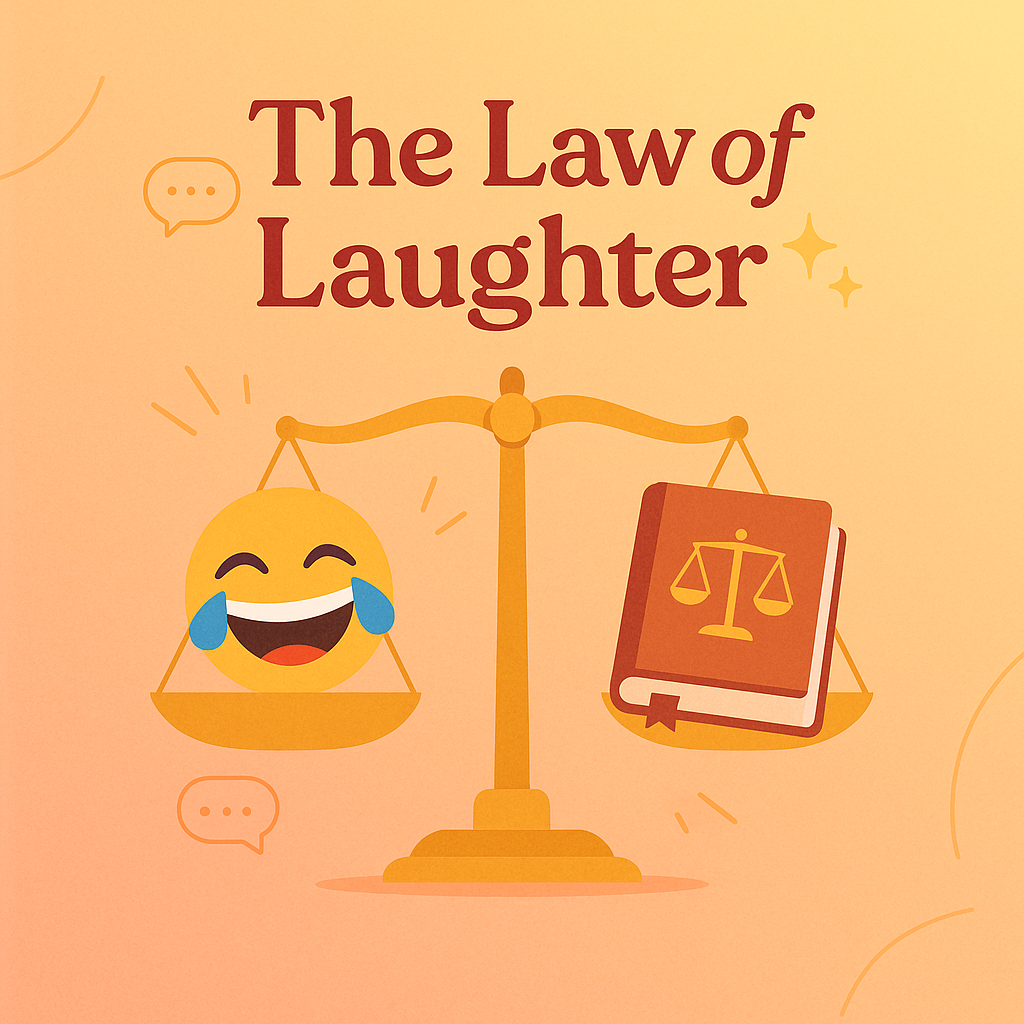
“the law of laughter: can you really get in trouble for a joke?”

We’ve all said something that didn’t land quite as intended — a joke that was a bit too dark, too bold, or just… too soon. But what happens when humour crosses the line from funny to legally risky?
In an age where memes go viral and tweets live forever, the question of whether a joke can get you in trouble isn’t just hypothetical — it’s happening every day.
When Jokes Become Legal Issues
The law doesn’t have a sense of humour (unfortunately).
While freedom of expression is protected under Article 10 of the European Convention on Human Rights (ECHR), that right isn’t unlimited. You can be restricted when speech causes harm, defames someone, or incites hatred or violence.
A famous example is Chambers v DPP [2012] EWHC 2157 (QB), better known as the “Twitter Joke Trial.” A man tweeted that he would “blow up” an airport if his flight was cancelled — as a joke. He was charged under the Communications Act 2003, s 127(1), for sending a “menacing” message.
Thankfully, the High Court eventually quashed the conviction, ruling that the tweet was clearly a joke. But it set a lasting precedent: intent matters, but so does perception.
Humour Has Consequences
Defamation law also has something to say about “harmless jokes.”
Even if a comment was made “in jest,” it can still be defamatory if it damages someone’s reputation in the eyes of a reasonable person.
A comedian can’t simply say, “it was only a joke,” if their statement implies a false fact.
Similarly, under the Public Order Act 1986, speech that’s intended (or likely) to stir up hatred can be prosecuted — even if disguised as comedy.
Context Is Everything
A courtroom doesn’t analyse your punchline — it analyses your intent and impact.
That’s why the same joke can be legal in one context and criminal in another. A stand-up show, where humour is expected, might get more leeway than a workplace email or social media post.
It all comes down to whether a “reasonable person” would see the joke as threatening, hateful, or defamatory.
The Balancing Act Between Freedom and Responsibility
Humour is part of human expression. It can challenge, provoke, and even heal — but it also has the power to harm.
The law doesn’t exist to police laughter; it exists to stop laughter from turning into cruelty.
So next time you’re about to post a joke online, ask yourself: would a judge find it funny? Probably not — but making sure it wouldn’t land you in court is a good start. 😅
References (OSCOLA)
- Communications Act 2003, s 127(1).
- Chambers v DPP [2012] EWHC 2157 (QB), [2013] 1 WLR 1833.
- Public Order Act 1986, s 18.
- European Convention on Human Rights, art 10.